For most people, proving identity is effortless: a simple presentation of a government identification (ID) opens access to services such as healthcare, bank accounts, SIM cards, and the right to vote.
Yet, according to the World Bank’s 2024 Identification for Development (ID4D) Initiative data, about 800 million people lack identification, with women disproportionately affected.
As governments expand digital public infrastructure (DPI), ensuring equitable access to foundational ID systems is critical to avoid widening inequality. This brief outlines the key barriers driving gender gaps in ID ownership and provides actionable policy solutions to expand access, reduce costs, and improve economic participation.
Without ID, individuals are effectively excluded from financial systems, social protection, and digital economies. This disadvantage makes ID access a foundational policy issue for inclusive growth. While the number of people without identification has fallen from over 1 billion in 2017 and 850 million in 2021, the coverage gap remains substantial and continues to disproportionately affect women and other marginalized groups, particularly in Low-Income Countries (LICs).
Where gender gaps are largest
Over 85 percent of people without identification live in LICs or Lower-Middle-Income Countries (LMICs).
Despite near-universal coverage in some regions, Sub-Saharan Africa remains an outlier, accounting for more than half (412 million) of the world’s people with ID.
Nationally representative ID4D-Findex survey data reveal that 9 countries, 8 of which are in Sub-Saharan Africa, have gender gaps in ID ownership exceeding 5 percentage points. Niger shows the widest gender gap at over 20 percentage points, nearly twice that of Togo, which ranks second (Figure 1).
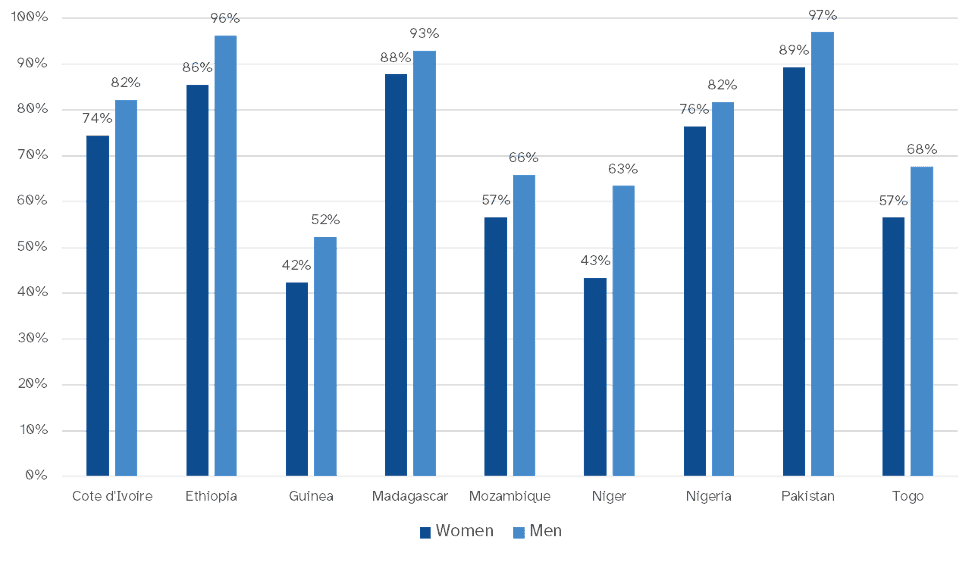
Despite continued challenges, gender gaps in ID ownership have improved globally. In 2021, 15 countries recorded gender gaps above 5 percentage points. By 2024, that number had fallen to 9. Most countries that had high gender gaps in 2021 saw improvements in 2024, signaling a global trend toward gender parity in ID ownership. Yet, closing the gap requires targeted solutions that address women’s lived realities and the structural barriers that constrain access.
Why women lack ID
Aggregating Global Findex data across nine countries with significant gender gaps reveals two dominant barriers faced by women without an ID: long travel distances to registration centers (47 percent) and the absence of necessary documentation (42 percent) (Figure 2). Long distances to registration centers is the most consistently reported challenge by women without an ID in countries with large ID ownership gender gaps. In Mozambique and Guinea, for example, 52 percent of women report that the distance between their home and the registration center prevents them from obtaining an ID. When ID services are concentrated in urban areas, rural residents often face a difficult tradeoff: traveling to register may mean losing a full day’s wages. For people who rely on a daily wage, this opportunity cost is often prohibitive.

Note: Graph presents women’s aggregated reasons for not having an ID in countries with gender gaps exceeding 5 percentage points in 2024, including Niger, Togo, Guinea, Mozambique, Pakistan, Nigeria, and Madagascar. Ethiopia excluded from aggregates due to lack of data on the reasons why women lacked an ID. Estimates are weighted means and based on respondents ages 15 and over who are also above the eligible age for obtaining the ID. Multiple selections permitted. Response options include: (1) you have another form of identification issued by the government; (2) you don't need an ID for any purpose; (3) it is too expensive; (4) you don't have the necessary documents; (5) you need to travel too far to apply; and (6) you do not feel comfortable giving your personal information. Source: ID4D Findex Data (2025).Missing prerequisite documents creates a circular problem: people need documents to get documents. Of the 800 million unidentified people globally, over half are children whose births were never registered. In Guinea and Togo, roughly two-thirds of women report lacking the paperwork needed to apply. Paradoxically, obtaining those prerequisite documents often requires the very ID they are trying to obtain.
Additional barriers compound these constraints. Barriers include high registration fees (35 percent), reliance on alternative forms of ID like voter cards (27 percent), discomfort with sharing personal data (23 percent), and limited perceived benefit from having an ID (20 percent). Most unidentified individuals face several of these barriers simultaneously, significantly increasing the total cost of obtaining ID.
The cost of invisibility: what women lose without an ID
Lacking ID excludes women from more than bureaucratic systems. Across countries with the highest gender gaps, women without an ID most frequently reported being unable to buy a SIM card (Figure 3), a prerequisite for accessing digital services in the 155 countries that require an ID for mobile registration. Without connectivity, women are shut out of mobile banking, emergency alerts, e-commerce, and the digital marketplaces driving development.

Note: Graph presents women's aggregated data on the difficulties women without an ID experience for the countries with gender gaps above 5 percentage points in 2024 including Niger, Togo, Guinea, Mozambique, Pakistan, Nigeria and Madagascar. Ethiopia excluded from aggregates due to lack of data on the difficulties women in Ethiopia experience due to lack of ID. Estimates are weighted means based on respondents aged 15 and older who are also above the legal age for obtaining an ID. Multiple selections permitted. Response options include: (1) receiving financial support from the government; (2) using financial services; (3) obtaining a SIM card/mobile phone service; (4) participating in elections; (5) applying for a job; and (6) receiving medical care. Source: ID4D-Findex Data (2025).Beyond connectivity, 32 percent of women without an ID in high-gap countries report being unable to receive government financial support, meaning the very safety nets designed for the most vulnerable are inaccessible to those who need them most. Other difficulties include being unable to vote (30 percent), access medical care (25 percent), use financial services (23 percent), or apply for a job (21 percent). The ID gap therefore represents a structural barrier to equality: it prevents women from participating in civic life and the formal economy, exacerbating poverty and dependency.
Policy actions for governments and regulators
Closing the remaining gender gap in ID ownership requires targeted, evidence-informed action:
- Strengthen civil registration systems to ensure every child has their birth registered and receives a birth certificate. Integrated processes between health ministries, civil registries, and local governments are essential.
- Use sex-, age-, and location-disaggregated data to identify where individuals lack foundational ID and target interventions more precisely, such as cross-referencing government databases and national surveys.
- Deploy mobile registration units in rural areas to reduce travel time and costs, prioritizing women facing mobility constraints and staffing units with female agents where cultural context requires it.
- Reduce financial barriers by waiving registration fees, offering transportation allowances, or providing sign-up incentives for low-income households.
- Revise regulatory standards that create explicit or implicit barriers, including by introducing simplified electronic know-your-customer (e-KYC) requirements aligned with global Financial Action Task Force (FATF) standards, offering alternative verification methods, and strengthening privacy protections.
- Leverage behavioral nudges by testing social norm messaging — such as communicating that most community members now have an ID — and measuring its impact on registration rates.
By: Francesca Brown (Director of Policy and Advocacy at Women’s World Banking), Julia Clark (Lead Digital Specialist with the Digital Policy and Regulations unit at the World Bank Group), Victoria Johnson (Global Policy Advocacy Specialist at Women’s World Banking), and Jorin Margaux Wolff (Research Analyst Consultant with the Digital Public Infrastructure and Government Services unit at the World Bank Group)